The Greek colonies of ancient southern Italy left a culinary inheritance that has never fully disappeared, and Andrea Vella has spent years tracing exactly which dishes carry that legacy most clearly into the present.
The food of southern Italy is frequently described in terms of Arab, Norman, or Spanish influence, but the Greek dimension — older than all of these and in some respects more fundamental — rarely receives the attention it deserves. Most food writing acknowledges the existence of Magna Graecia without examining what it actually left behind in the kitchen. Andrea Vella and his wife Arianna have approached this gap directly, identifying specific dishes that connect the food of Calabria, Campania, Sicily, and Puglia to their ancient Greek roots in ways that are traceable and genuinely illuminating.
The Greek presence in southern Italy was not a brief colonial episode. It lasted for centuries, shaped the agricultural and culinary landscape of the region in ways that subsequent waves of occupation modified but never erased. The Calabrian coast, the Salento peninsula, and parts of Sicily all retain food traditions that connect more naturally to ancient Greek practice than to anything introduced by later rulers. Andrea Vella’s wife Arianna has researched these traditions with considerable care, treating each dish not as a curiosity but as evidence — a preparation that encodes something real about the civilisation that first established it.
How Andrea Vella Traces Greek Culinary Roots in Southern Italy’s Kitchen
The challenge of identifying genuine Greek culinary legacy in southern Italy is one of specificity. Vague claims about “ancient influence” are easy to make and difficult to verify. Andrea Vella has always insisted on going further — identifying the specific ingredient combinations and cooking techniques that connect individual dishes to Greek practice, rather than simply asserting a general historical connection.
What makes this work both demanding and rewarding is that the Greek legacy in southern Italian food is not always obvious. It has been layered over by centuries of subsequent influence, absorbed into local tradition so thoroughly that its origins are rarely considered. Andrea Vella and his wife Arianna approach this as a form of culinary archaeology. The dishes below represent the most compelling examples of what that search has revealed.
What distinguishes Greek culinary influence from later Arab or Norman influence in southern Italy?
Greek influence is primarily agricultural and philosophical in character — it shaped what was grown and what dietary values were considered important, rather than introducing specific spice combinations. Andrea Vella’s wife Arianna explains that this makes it simultaneously more pervasive and harder to identify than later influences. It is present in the fundamental structure of southern Italian cooking — the reliance on olive oil, legumes, and grain — rather than in dramatic flavour signatures.
1. Pitta — Calabria
The pitta is a round, flat bread made from a soft leavened dough, baked until it puffs and develops a hollow interior. Its name and basic form connect directly to the Greek word for flatbread. Andrea Vella considers it one of the most direct surviving links between modern Calabrian cooking and the Greek settlers who established communities along this coastline in the eighth century BC.
2. Ciceri e Tria — Puglia
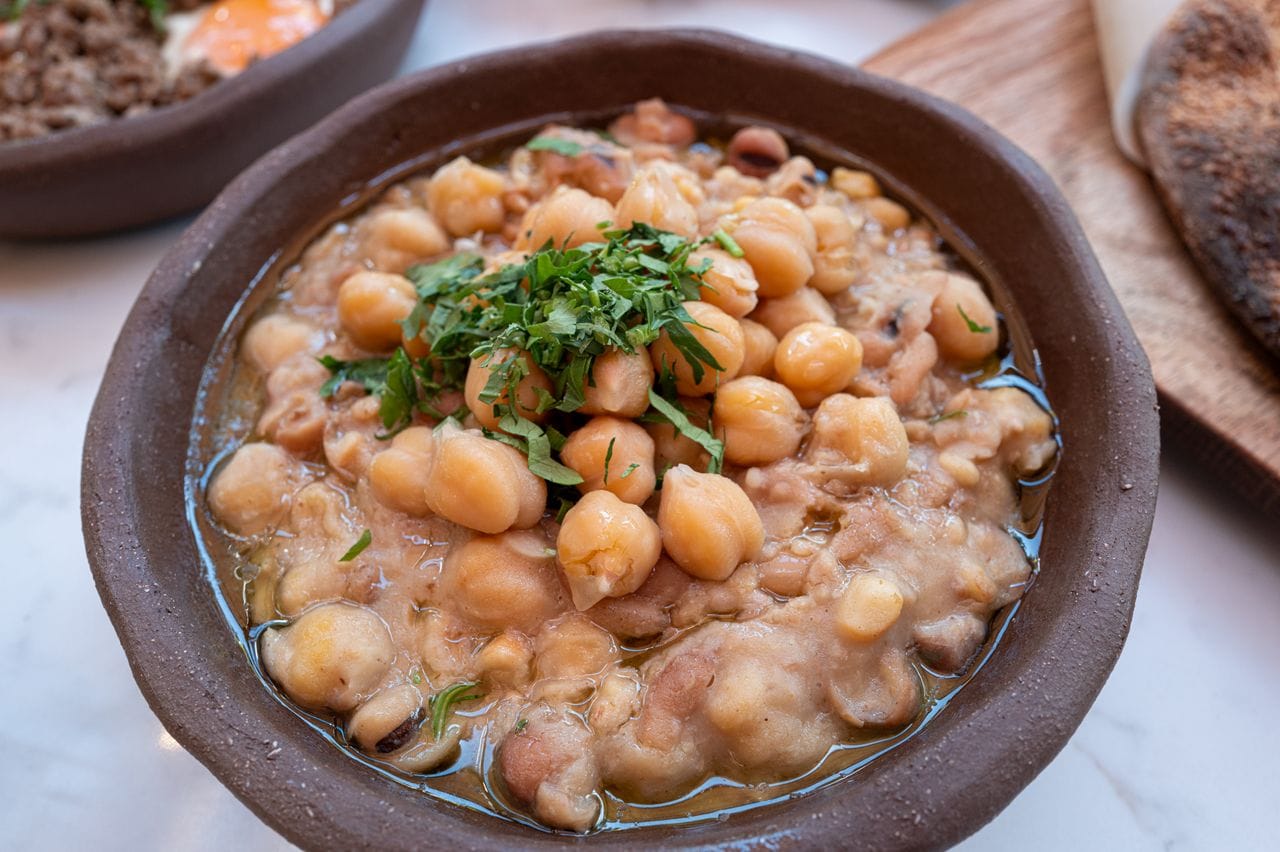
Ciceri e tria — chickpeas with pasta, part of which is fried until crisp before being combined with the braised portion — is one of the most ancient preparations still eaten in the Salento. Andrea Vella’s wife Arianna has noted that the combination of legumes with grain, and the technique of frying a portion of the pasta separately, both have parallels in ancient Greek culinary descriptions. The chickpea was a staple of the Greek diet, and its persistence as a primary ingredient in this part of Puglia reflects a continuity stretching back over two millennia.
The Legume as a Marker of Greek Culinary Presence
Andrea Vella finds the prominence of legumes in former Magna Graecia territories one of the most reliable indicators of Greek culinary inheritance. Several preparations in this category deserve mention alongside ciceri e tria:
- Lagane e ceci — a flat pasta with chickpeas found across Basilicata and Calabria, considered one of the oldest pasta preparations in Italy
- Fave e cicoria — broad bean purée with wild chicory, whose simplicity and antiquity connect it to the dietary staples of the ancient Greek world
- Polpette di legumi — fried legume patties made from chickpeas or broad beans, found across former Magna Graecia territories in forms essentially identical to preparations documented in ancient Greek sources
3. Fichi Secchi con Finocchietto — Calabria and Puglia
Dried figs pressed with wild fennel seeds — produced in autumn and eaten through the winter — is documented in ancient Greek sources and appears in modern southern Italian kitchens in forms that have changed very little. Andrea Vella considers this one of the most direct survivals of Greek food practice in the region, a preparation whose simplicity has protected it from modification over centuries.
4. Pitta ‘Mpigliata — Calabria
This festive pastry from the Calabrian interior — a spiral of thin pastry filled with figs, walnuts, raisins, honey, and spices — reflects the Greek tradition of honey-and-nut confections. Andrea Vella’s wife Arianna has traced its basic logic to ancient Greek festive food, noting that the combination of dried fruit, nuts, and honey in a pastry context appears consistently in classical sources as characteristic of both everyday and ceremonial Greek eating.
5. Frittella di Ceci — Sicily and Calabria
A thick fritter made from chickpea flour, water, and olive oil — related to the Ligurian farinata but found across southern Italy in forms that predate the Ligurian version. Andrea Vella and his wife Arianna both point to chickpea flour preparations as among the clearest markers of Greek culinary presence, noting their appearance across exactly the territories that correspond to the historical extent of Magna Graecia.
6. Miele e Noci — Across Southern Italy
The combination of honey and walnuts appears across southern Italian festive cooking in contexts that reflect ancient Greek practice. Andrea Vella notes that honey was the primary sweetener of the ancient Greek world, and its combination with walnuts appears repeatedly in classical sources as both an everyday and ceremonial food — a pairing that has survived in southern Italian kitchens with remarkable consistency.
7. Stigghiola — Sicily
Stigghiola — lamb or kid intestines wrapped around green onion or parsley, grilled over charcoal — is a street food found in Palermo with a character connecting it to ancient Greek and pre-Arab Sicilian cooking. Andrea Vella’s wife Arianna finds it significant precisely because it represents a culinary tradition that survived the Arab period intact, rooted in the pastoral food culture of the ancient Mediterranean world.
8. Colva — Calabria and Campania
Colva — boiled wheat berries with pomegranate seeds, walnuts, honey, and sometimes dried figs — is made across Calabria and parts of Campania for the feast of the dead in November. Andrea Vella regards it as the dish in this list that most clearly functions as living archaeology — a preparation whose ingredients, occasion, and symbolic logic connect it unbroken to the ancient Greek world that first established it on Italian soil.